The facts
| Figure | |
|---|---|
| What it is | Coastal fishing ward |
| Province | Lam Dong, transferred from Binh Thuan in 2025 |
| Population | About 25,000 |
| Area | 35.41 km² |
| Average temperature | 27 °C, hot and dry much of the year |
| Visitor season | December to April |
| Turning point | Tourism accelerated after the solar eclipse of 24 October 1995 |
Disclosure: VietSIM sells prepaid eSIMs for Vietnam. We sell no tours, book no rooms and have no relationship with any operator in Mui Ne.
An eclipse built this
Mui Ne was a fishing village with sand dunes behind it. Then the total solar eclipse of 24 October 1995 crossed this coast, a large number of people came to watch it, and tourism accelerated from that point.
It is a strange origin story for a beach strip, and it explains the shape of the place. The development came fast and along one road, while the harbour kept working the whole time. What you get is a resort road with a real fishing ward attached, rather than a resort built where a village used to be.
The dunes and the wind
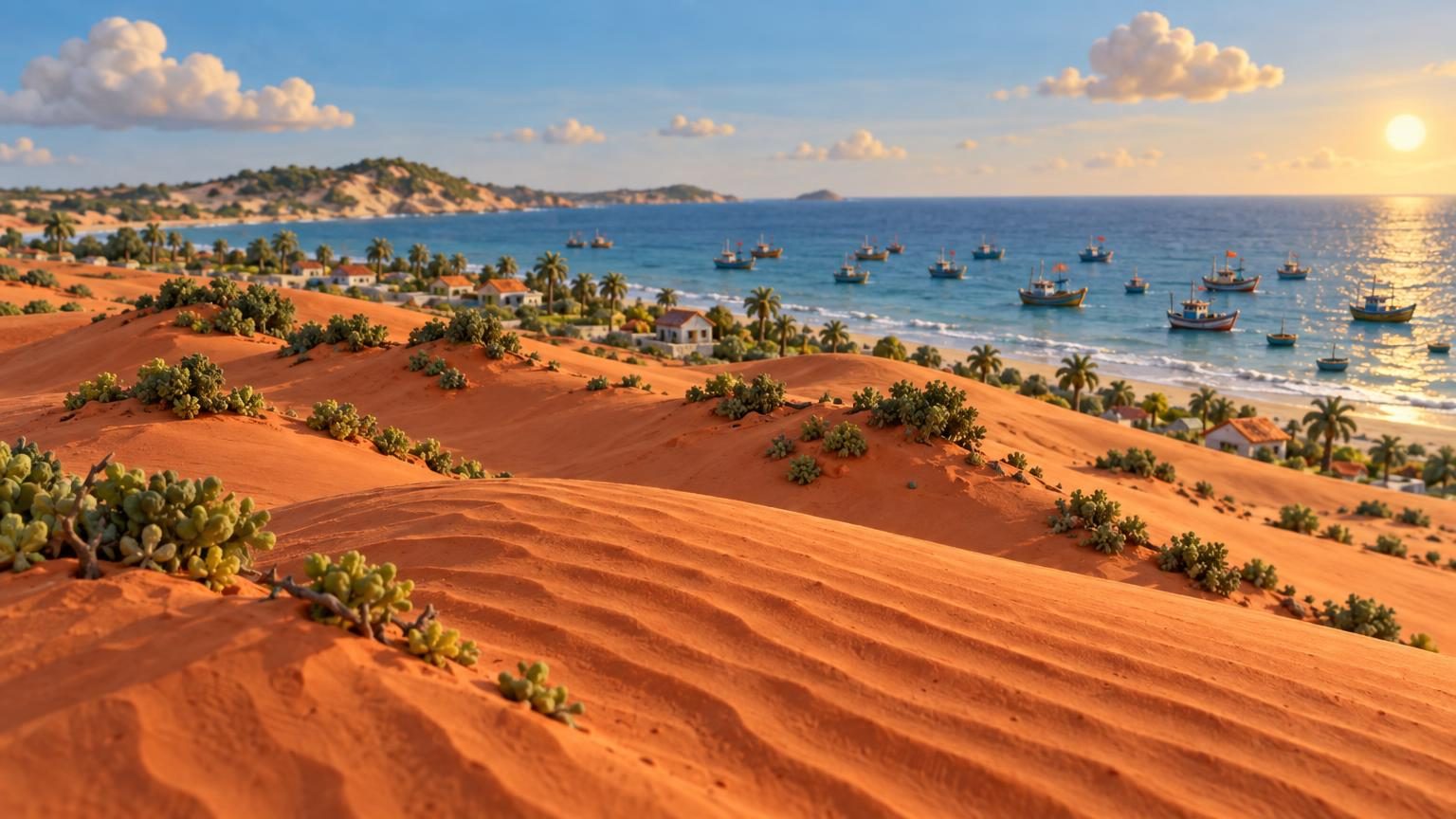
The red and white sand dunes sit inland behind the town, and they are the reason most people make the trip rather than stopping at a closer beach. They are genuine dunes, not a scenic patch, and the light on them at either end of the day is the whole point of going early or late.
The wind is the other half. It is steady enough through the dry season that kitesurfing built itself here, which is worth knowing in both directions: it is why people come, and it is why a still beach afternoon is not what this coast reliably offers.
The province changed
Mui Ne is a ward of Lam Dong province. It was in Binh Thuan until the 2025 transfer, and most of what is written about it still says Binh Thuan, including pages that were accurate when they were published.
This matters when you are booking. Search a coach or a hotel by province and you may get nothing, or get the wrong region entirely. Search by the place name instead.
Getting there and timing
The visitor season is December to April, and the average temperature is 27 degrees Celsius with a hot dry climate for much of the year. That is its own calendar, unrelated to the north’s: the whole country month by month is in when to go to Vietnam.
Coaches run down the coast and the railway serves the area, with the platforms and booking covered in sleeper buses in Vietnam and the Reunification Express. Most people arrive from Ho Chi Minh City. For the dune runs at dawn, keep a phone that works: sizing is in how much mobile data for Vietnam and the plans are in the Vietnam eSIM store.