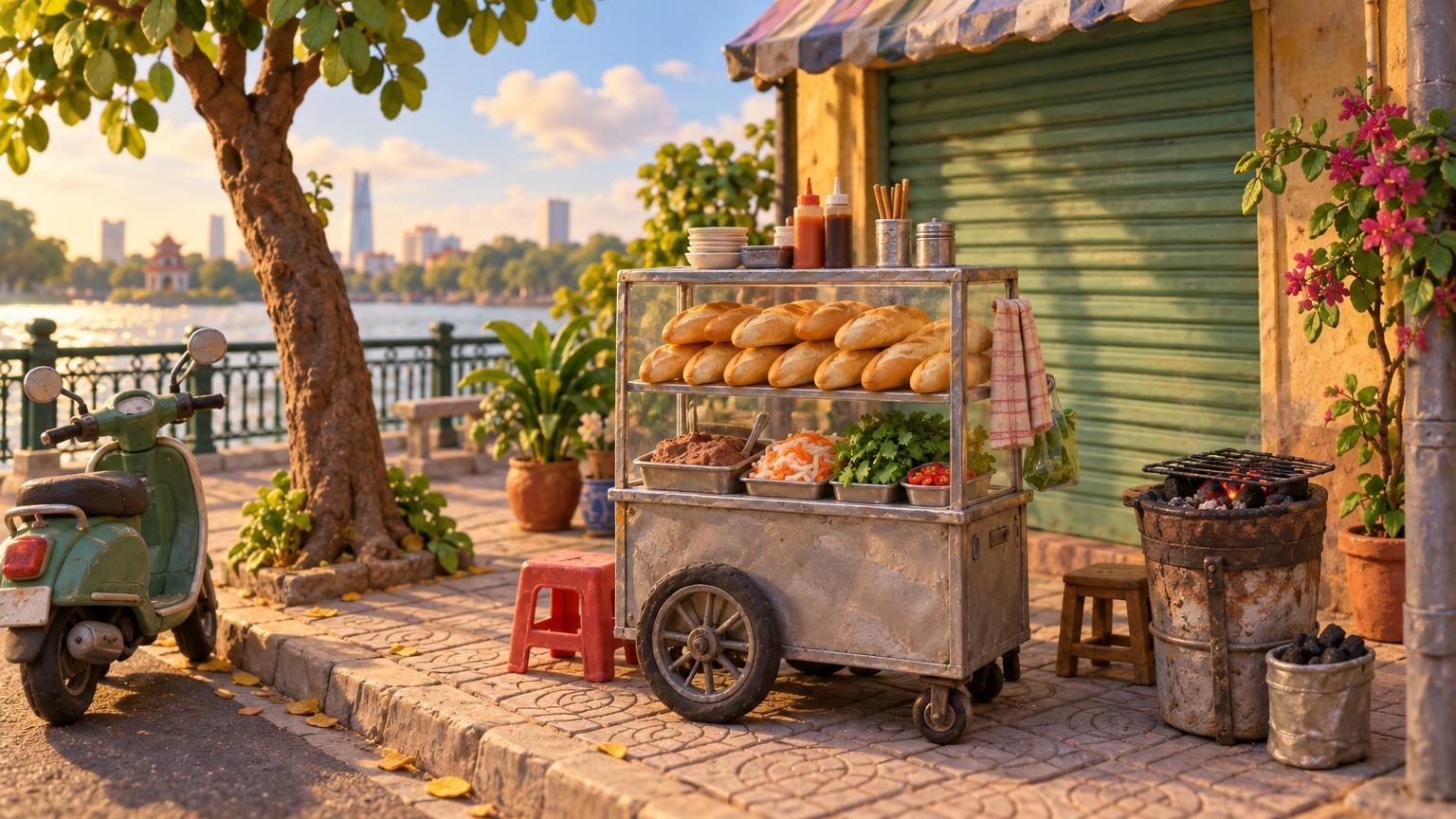
The facts
| Figure | |
|---|---|
| The bread | Short baguette, thin crisp crust, soft airy crumb |
| Flour | Wheat, often with rice flour as well |
| Baguette arrives | 1860s, with French rule |
| Vietnamese sandwich | Developed in Saigon in the 1950s |
| Early shop | Hoa Ma, selling banh mi thit from 1958 |
| Typical filling | Vietnamese sausage, coriander, cucumber, pickled carrot and daikon, pate, chilli, mayonnaise |
| Dictionary | Added to the Oxford English Dictionary on 24 March 2011 |
| Names | Banh mi in the south, originally banh tay in the north |
Disclosure: VietSIM sells prepaid eSIMs for Vietnam. We sell no food and recommend no specific cart on this page.
Start with the bread
Everything about banh mi follows from the loaf. It is a short baguette with a thin, crisp crust and a soft, airy interior, and it may be made with rice flour as well as wheat. That mixture is what makes the crumb light enough to compress into a sandwich without turning into a jaw exercise.
This is why banh mi made abroad so often disappoints. A French baguette in a Vietnamese filling is a different object: heavier crust, denser crumb, and a bite that fights the pickles instead of carrying them.
Two dates
The French introduced the baguette in the 1860s, at the beginning of their rule in Vietnam. That is the import. The sandwich is not.
In the 1950s a distinctly Vietnamese style developed in Saigon and became street food, and in 1958 Hoa Ma became one of the first shops selling banh mi thit. Nearly a century separates the arrival of the bread from the invention of the thing people queue for, which is the part most summaries collapse.
The name records the same split. In the south the bread was called banh mi, wheat banh. In the north it was banh tay, Western bread. The southern name is the one that travelled, and on 24 March 2011 it was added to the Oxford English Dictionary.
From a French loaf to a dictionary entry
1860s
The French bring the baguette
The import, at the beginning of French rule.
1950s
The Vietnamese sandwich develops in Saigon
Nearly a century after the bread arrived.
1958
Hoa Ma sells banh mi thit
One of the first shops to sell it.
24 March 2011
Banh mi enters the Oxford English Dictionary
Under the southern name, not the northern banh tay.
What is inside, and why
A common build is Vietnamese sausage, coriander, cucumber, pickled carrot and pickled daikon, with pate and mayonnaise from the French side, plus red chilli.
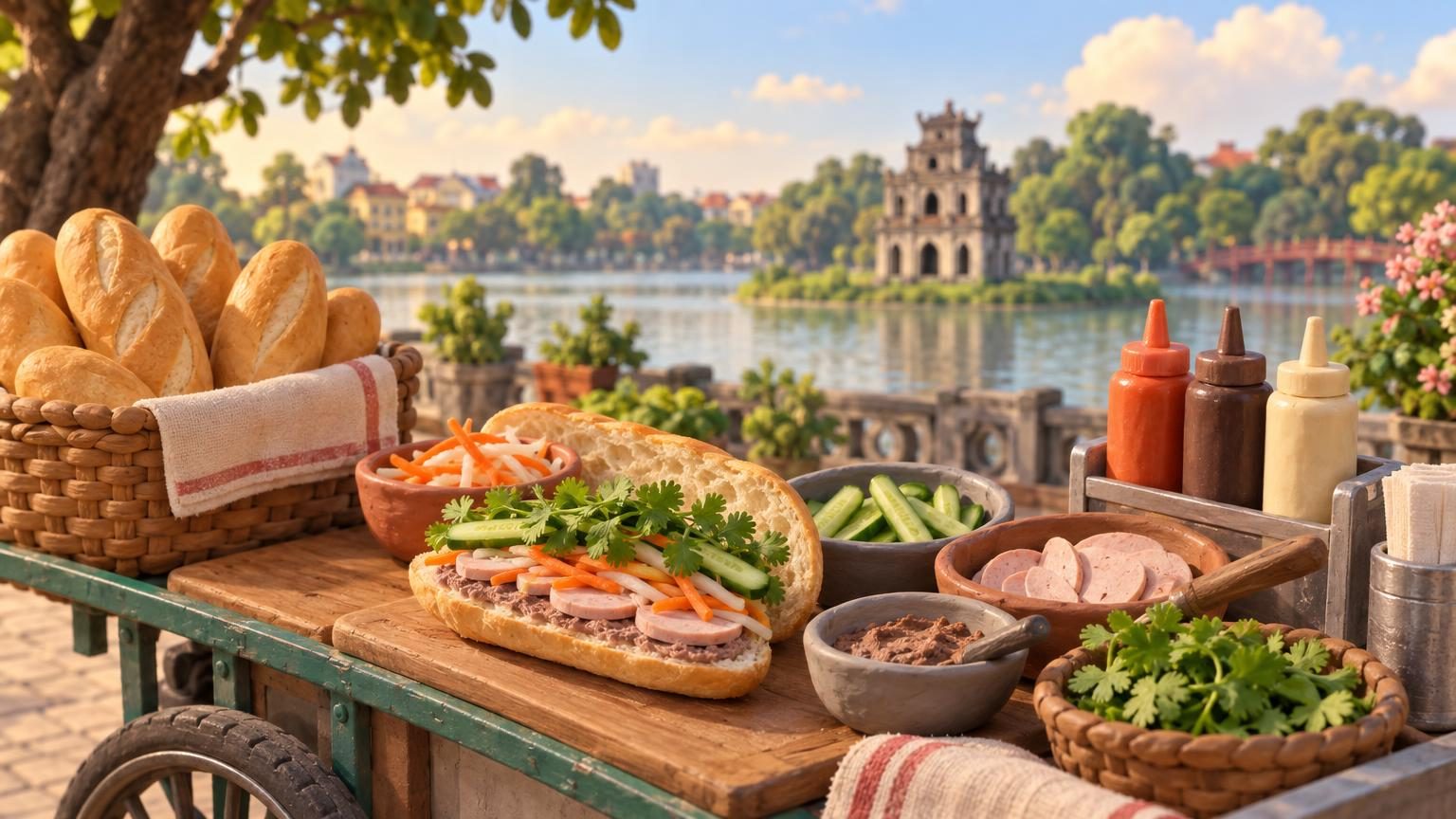
The pickles are the working part. Pate and mayonnaise are rich, the sausage is rich, and the pickled carrot and daikon cut straight through both. A banh mi without them is a pork roll. With them it balances, which is the reason the same handful of ingredients has survived seventy years of variation.
Eating well
- Watch where the bread comes from. A cart with a fresh delivery through the day is a different proposition from one working off a morning stack.
- Ask for it as it comes first. The default build is a balance somebody worked out; change it on the second one.
- Không cay if you do not want chilli. More in Vietnamese phrases.
- It is breakfast and it is a snack. Two small ones through a day beats one large one at lunch.
Around it
The other great Vietnamese breakfast is in pho, the rest of the street is in Vietnamese street food, and what to drink with it is in Vietnamese coffee. Reading the price is in Vietnam’s money.
Finding the cart people actually queue at is a connected activity: sizing is in how much mobile data for Vietnam with the plans in the Vietnam eSIM store.