Suitcase packed with a rain jacket, hat, adapter and first aid tin, clay model

Plugs and power in Vietnam: 220 V, type C and F, and your charger

Short answer

Vietnam runs on 220 V at 50 Hz with type C and type F sockets, the two round-pin European shapes. Most phone and laptop chargers accept 100 to 240 V, so an adapter is enough and a converter is not. Power banks must travel in hand baggage, and IATA's limit is 100 Wh.

Last checked:

VietSIM sells prepaid Vietnam eSIMs. This guide mentions our store where it is relevant; the facts come from the sources listed at the end.

The numbers

Vietnam
Voltage 220 V, listed as 220/380 V
Frequency 50 Hz
Socket types C and F
Type C Europlug, two round pins, ungrounded
Type F Schuko, two round pins with earth clips

Disclosure: VietSIM sells prepaid eSIMs for Vietnam. We do not sell adapters, and a plug page that tries to is not worth reading.

Adapter, not converter

This is the distinction that saves people money and worry. An adapter changes the shape of the pins. A converter changes the voltage. Vietnam’s 220 V is the same range as most of Europe, Asia and Africa, and different from North America’s 120 V.

Turn your charger over. If the small print says 100 to 240 V, 50 to 60 Hz, then the charger already does the conversion internally and all you need is the right shape. That covers essentially every modern phone, laptop, tablet and camera charger.

If something says 120 V only, leave it at home. Hair dryers and straighteners are the usual offenders and hotels usually have one anyway.

The socket you will meet

Vietnam is listed with type C and type F: the round two-pin shapes familiar across continental Europe. A universal travel adapter handles them, and so does a standard European plug.
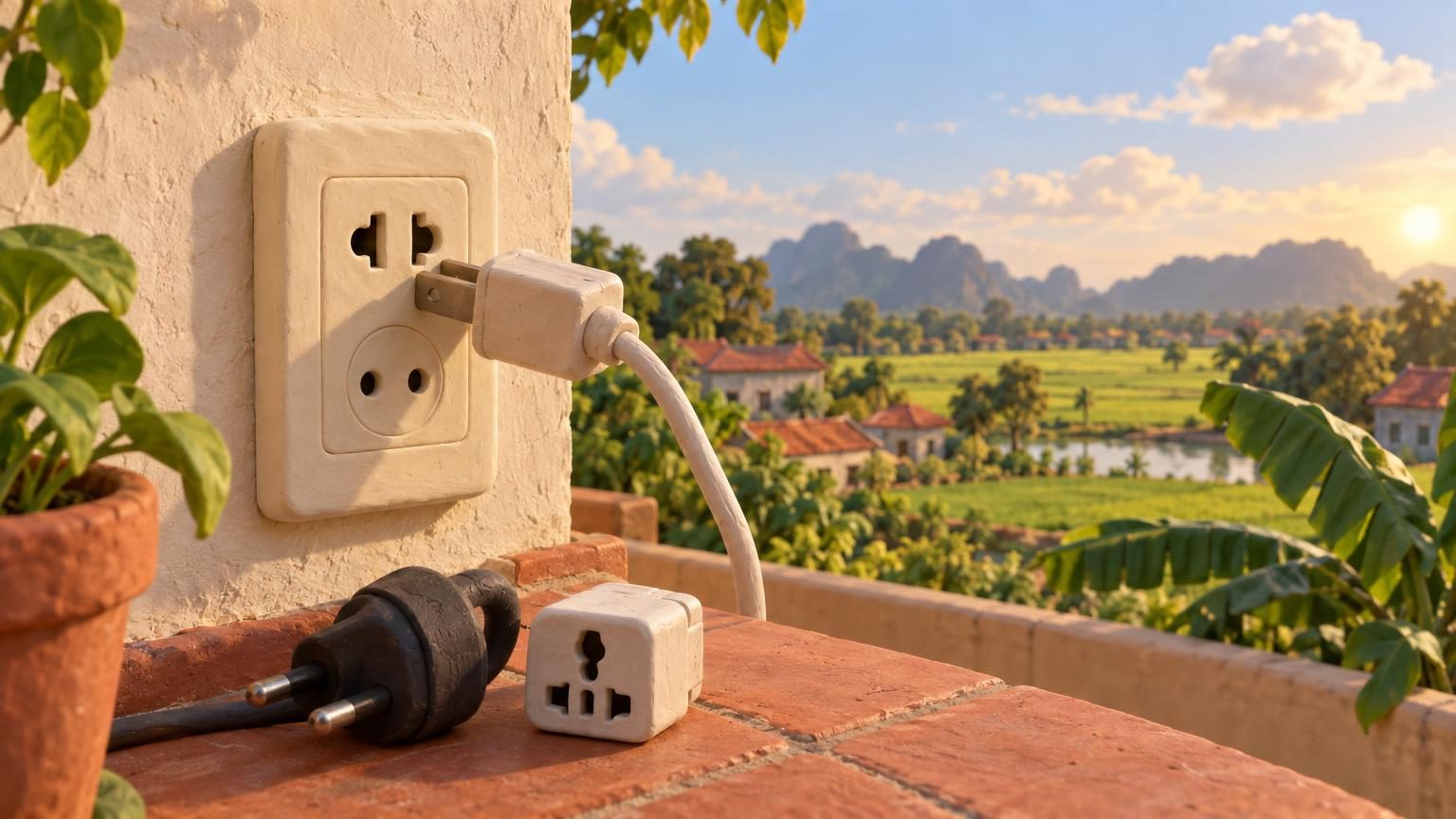
A wall socket with round and flat slots in one face, a round two-pin plug and a travel adapter below it
Most sockets take both shapes, which is why one adapter is usually enough.

The practical advice is to bring one adapter with several USB ports rather than several adapters. Hotel rooms rarely have enough sockets, and the ones they do have are often behind the bed.

Power banks, and the rule that matters

IATA is direct about this: all lithium-powered devices and spare batteries must only be carried in hand baggage. That means a power bank never goes in the hold, on any airline, ever.

  • Up to 100 Wh is generally accepted in the cabin.
  • 100 to 160 Wh may be allowed with airline approval.
  • Above 160 Wh is usually refused.

Keep terminals covered or the bank in its case so nothing shorts against keys or coins.

Why this matters more than it sounds

A phone in Vietnam is doing several jobs at once: maps, the ride app, translation, the hotel’s messages and photographs. That is a heavy day for a battery, and hotspot sharing makes it heavier still, which Apple’s own hotspot documentation implies when it notes that support varies by carrier and model.

A flat phone at ten at night is not an inconvenience, it is no ride and no address. How the ride apps work is in Grab in Vietnam, how much data the trip needs is in how much mobile data for Vietnam, and the plans are in the Vietnam eSIM store.

Questions

Do I need a voltage converter?

Almost certainly not. Look at the small print on the charger itself: if it says 100 to 240 V, as nearly every phone, laptop and camera charger does, it handles Vietnam's 220 V without help. A converter is only for single-voltage appliances, which for most travellers means a hair appliance and nothing else.

Which adapter should I bring?

One that offers the round two-pin shapes, since Vietnam lists type C and type F. A universal adapter covers it, and so does a plain European plug if you are coming from most of continental Europe. What matters more is how many USB ports it has, because that is what you will actually use.

Can I put a power bank in my checked bag?

No. IATA is unambiguous: all lithium-powered devices and spare batteries must only be carried in hand baggage. Up to 100 Wh is generally accepted, 100 to 160 Wh may need airline approval, and above 160 Wh is usually refused outright.

How big a power bank do I need?

Bigger than you think if you use the phone for maps, rides and photos all day, and much bigger if anyone tethers to it. Apple notes that Personal Hotspot support depends on the carrier and model, but the battery cost of sharing is the same everywhere: nothing empties a phone more quickly.

What happens if the phone dies?

You lose the ride, the map and the address at the same time, because they all live in the same device. Ride apps price the trip before you book and then message you about the pickup, which needs a phone that is still on. Carry the cable, not just the bank.

Sources

  1. Wikipedia: Mains electricity by country
  2. IATA: safe travel with lithium batteries
  3. Apple Support: set up a Personal Hotspot
  4. Grab Vietnam: booking a car in the app