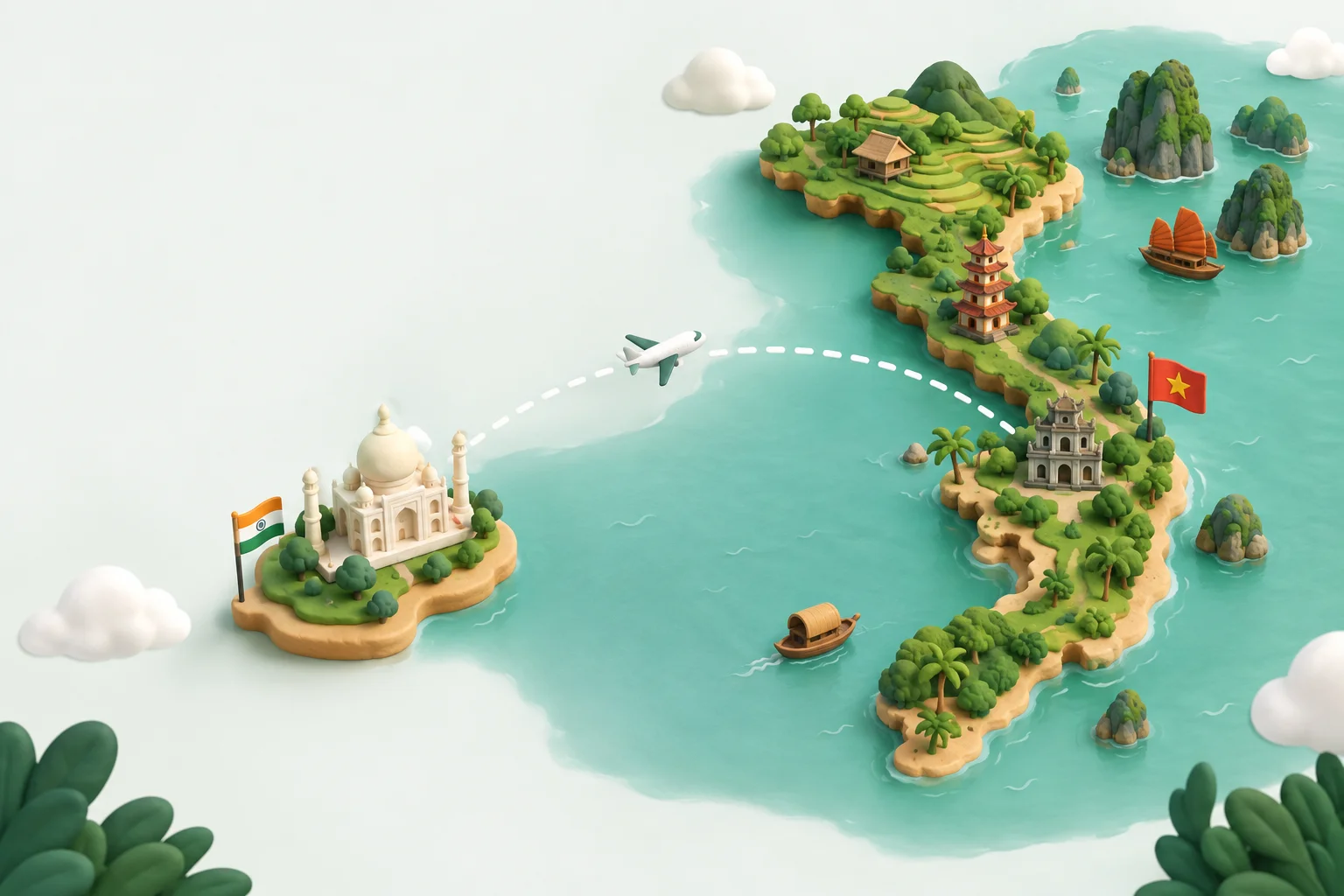
Why an eSIM makes sense for Indian travellers
If you are flying from Delhi, Mumbai, Bengaluru or Chennai, your first hours in Vietnam are likely to involve immigration, baggage and a taxi. Buying a physical SIM at the airport adds another queue, another form and another payment in a currency you have just met. An eSIM skips all of that: you buy it before you leave India, install it at home, and it connects when you land.
There is also the practical matter of your Indian number. Most phones sold in India support dual SIM, so you can keep your Jio, Airtel or Vi line active for OTPs and WhatsApp while the eSIM handles data. You do not have to remove your Indian SIM, and you do not have to pay international roaming rates.
What you actually need to check before buying
Not every phone sold in India supports eSIM. The feature is common on recent iPhones and on many flagship Android devices, but it is not universal. Check your phone's settings for an "Add eSIM" or "Add cellular plan" option before you buy. If you are unsure, our Vietnam eSIM for Android and Vietnam eSIM for iPhone guides walk through the exact menus for each platform.
You should also confirm your phone is carrier-unlocked. A phone locked to Jio or Airtel will not accept a travel eSIM. Most phones bought outright in India are unlocked, but it is worth checking if you bought yours on a contract.
How to buy and install from India
- Choose a plan in the Vietnam eSIM store. Plans are listed by data allowance and validity, so pick based on how long you are staying and how much you expect to use.
- Pay online. Checkout is in US dollars. Your Indian bank or card will convert to rupees; the exact rupee amount depends on your card's exchange rate and any foreign transaction fee.
- Receive the QR code by email, usually within minutes.
- Install the eSIM while you are still in India, on Wi-Fi. The installation itself does not activate the plan; it just adds it to your phone.
- Activate on landing. Turn on the eSIM line and enable data roaming for that line. The plan's validity and activation rules come from the product record, so check the plan details for the exact trigger.
If anything goes wrong, our Vietnam eSIM activation guide covers the common first-connection problems.
Rupee prices: what to expect
VietSIM prices are set in US dollars. The rupee figure you see on your statement depends on your bank's rate on the day and any markup your card applies. As a rough guide, a short trip plan costs less than a meal for two in a mid-range Hanoi restaurant; a longer, larger plan costs more but still less than a day of international roaming on most Indian postpaid plans.
For a fuller breakdown of what changes the price, see our Vietnam eSIM price guide.
| Trip length | Typical data need | What to look for |
|---|---|---|
| 3–5 days | Maps, messaging, light browsing | A small plan with a short validity window |
| 7–10 days | Maps, messaging, some video | A mid-size plan; check if hotspot is included |
| 14 days or more | Regular use, maybe remote work | A larger plan or an unlimited option |
If you plan to tether your laptop or share data with a travel companion, check the plan's hotspot terms before buying. Our Vietnam eSIM hotspot guide explains how tethering works and how much data it uses.
What works on arrival
When you land at Tan Son Nhat, Noi Bai, Da Nang or Phu Quoc, turn off airplane mode, select the eSIM as your data line, and wait for it to connect. It usually takes under a minute. If it does not connect, toggling airplane mode or restarting the phone often fixes it.
Your Indian number stays active for calls and SMS if you keep that line enabled, but data will route through the eSIM. WhatsApp will continue to work on your Indian number as long as you have a data connection.
Common questions from Indian travellers
Can I buy a Vietnam eSIM in India? Yes. You buy it online before you fly, install it on Wi-Fi, and activate it when you land.
Will my Indian number still work? Yes, if your phone supports dual SIM and you keep your Indian line active. You will not be able to receive OTPs if you remove the Indian SIM.
Is it cheaper than international roaming? For most Indian postpaid plans, yes. Roaming packs are priced per day and add up quickly on a two-week trip.
Do I need a VPN? No. Vietnam does not block WhatsApp, Google or most international services. Some sites are restricted, but that is not usually a concern for tourists.
What if my phone does not support eSIM? You can buy a physical SIM on arrival. Our airport guides cover Tan Son Nhat and Noi Bai.
Can I top up if I run out? Check the plan details. Some plans allow top-ups; others do not. If you are unsure, buy a slightly larger plan than you think you need.