
ENLanguage
Vietnam travel guide for staying connected
SIM cards and eSIM, the three networks, Wi-Fi, the apps you need and city-by-city tips, checked against carrier and official sources.
Before you go

+84 Code: What Vietnam's Country Calling Code Is and How to Dial It
Vietnam's country calling code is +84. To call a Vietnamese mobile from abroad, dial +84, drop the leading 0 of the local number, then the remaining digits; to call a landline, dial +84, the area code without its leading 0, then the subscriber number. If you are travelling to Vietnam, the practical move is a data eSIM for maps, Grab and messaging, with a voice app for calls rather than international roaming.
Read the guide
Does a Vietnam eSIM come with a phone number?
Most travel eSIMs for Vietnam carry data only and no number, which is enough for maps, messaging and calls through apps. You need a Vietnamese number when an app sends an SMS code, such as Zalo. Prepaid numbers are registered to a passport under Decree 163/2024/ND-CP, so a plan that includes one is registered for you.
Read the guide
Viettel, VinaPhone or MobiFone: how Vietnam's three networks compare
Vietnam has three mobile networks for visitors: Viettel, VinaPhone and MobiFone. All three are state-owned, run 4G and have launched 5G: Viettel on 15 October 2024, VinaPhone on 20 December 2024 and MobiFone on 26 March 2025. The right network depends on your route, how long you stay and whether you need a local number.
Read the guide
Pocket Wi-Fi or eSIM for your trip to Vietnam?
An eSIM puts mobile data on your own phone, with nothing extra to carry, charge or return. A pocket Wi-Fi router is a separate device that shares one connection: Global WiFi, a Japanese rental firm, lets up to 5 devices connect to its Vietnam routers. A router suits groups sharing one plan; solo travellers rarely need one.
Read the guide
Apps to install for Vietnam: Grab, Be, Green SM, Zalo and payments
Grab works in Vietnam for cars, motorbikes and food, and you can pay in cash or by card. As of September 2026, Grab's help centre lists a 4% foreign payment fee on cards issued outside Vietnam. Be and Green SM (formerly Xanh SM) are local ride apps. Zalo, with 78.3 million monthly users in mid-2025, is Vietnam's main messaging app.
Read the guide
Vietnam phone and internet FAQ: WhatsApp, hotspot, 5G and calls
Yes. WhatsApp messages and calls run over mobile data or Wi-Fi in Vietnam, and your account stays on your home number when you use a Vietnamese SIM or eSIM. The blocking order Vietnam issued on 21 May 2025 named Telegram, not WhatsApp. For normal calls on a Vietnamese line, use a phone with VoLTE.
Read the guide
Vietnam visa for Indians: the e-visa, the fee in rupees and the rules
Indian passport holders need a visa for Vietnam, and the e-visa is the usual route: apply at evisa.gov.vn, pay 25 US dollars for single entry or 50 for multiple, and stay up to 90 days. That was about ₹2,400 or ₹4,800 on 24 September 2026. Phu Quoc alone allows 30 days without a visa.
Read the guide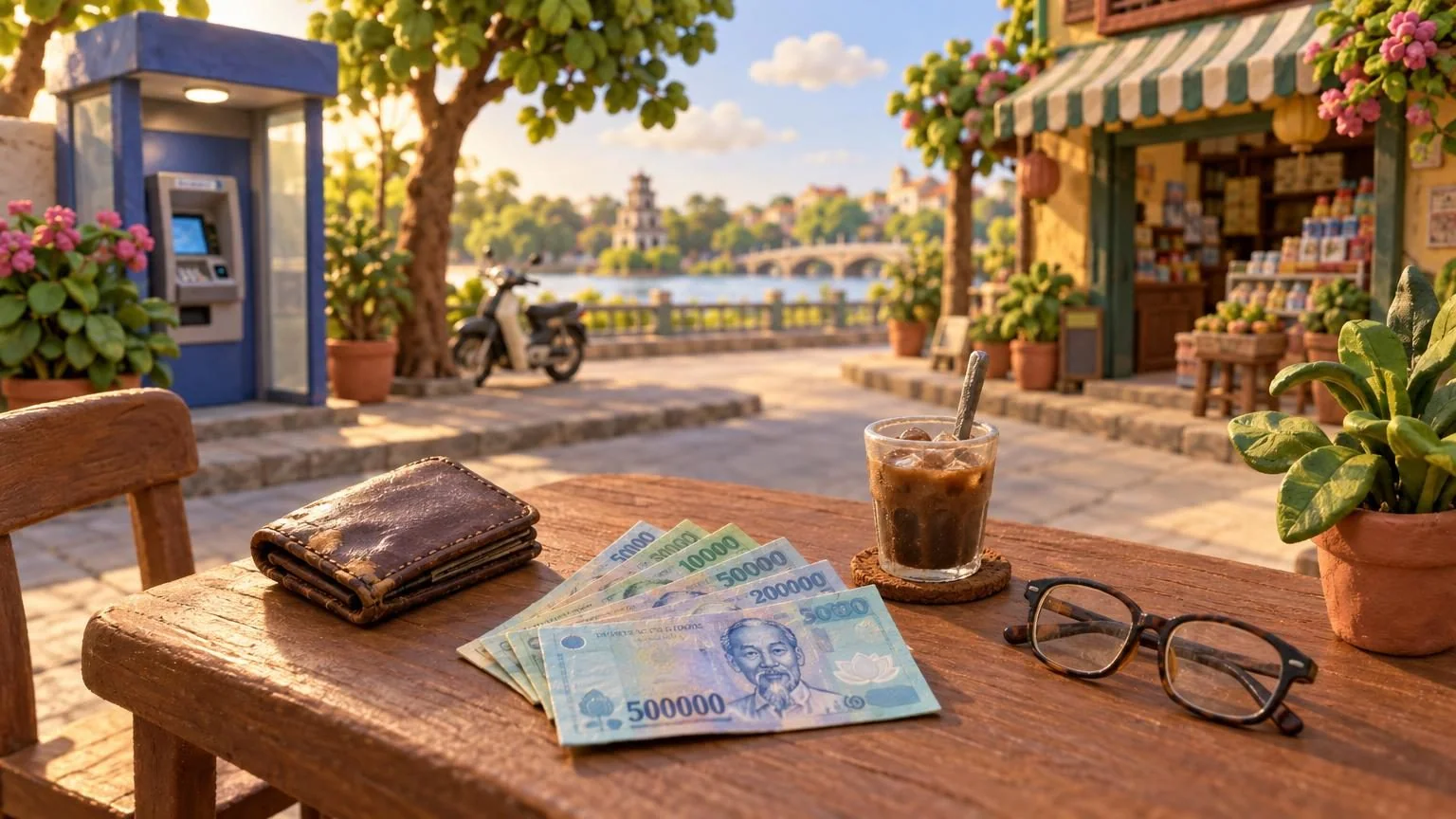
Vietnamese dong to Indian rupees: the rate, the shortcut and how to carry money
On 24 September 2026 one Indian rupee was worth about 271 Vietnamese dong, so 100,000 dong was about ₹369. A quick shortcut: drop the last three zeros of a dong price and multiply by 3.7. Rupee notes are hard to change in Vietnam, so carry US dollars or a forex card.
Read the guide
Flights from India to Vietnam: Delhi, Mumbai and the direct routes
Around 80 direct flights a week linked India and Vietnam in September 2026. Delhi and Mumbai have nonstop flights to Hanoi and Ho Chi Minh City on Indian and Vietnamese airlines, taking about 4 to 5.5 hours. Vietnam is 1 hour 30 minutes ahead of India all year.
Read the guide
Vietnam trip cost from India: the fixed costs in rupees, and what moves the rest
No honest page can quote one figure for a Vietnam trip, because fares and prices move. The fixed costs from India are clear: the e-visa is 25 or 50 US dollars, about ₹2,400 or ₹4,800, and a tour package attracts 2% TCS from April 2026. Flights, season and pace decide the rest.
Read the guide
Vegetarian food in Vietnam: chay, hidden fish sauce and Indian food
Vegetarian food in Vietnam means looking for chay, the Buddhist vegetarian cooking served at places signed quán chay or cơm chay, often near pagodas. Ordinary dishes hide fish sauce, shrimp paste and meat broth, so say tôi ăn chay. Many Vietnamese eat vegetarian on the 1st and 15th of each lunar month.
Read the guide
Staying connected in Da Nang and Hoi An: SIM, eSIM and getting around
Da Nang International Airport (DAD) sits about 3 to 5.5 km from central Da Nang and about 29 km from Hoi An Ancient Town, as of September 2026. Install an eSIM before you fly or buy a SIM at the airport with your passport, then book Grab, Be or Xanh SM.
Read the guide
Staying connected in Nha Trang: SIM, eSIM and getting around
Nha Trang is served by Cam Ranh International Airport (CXR), about 35 km from the city, a ride of about 45 to 60 minutes as of September 2026. Install an eSIM before you fly or buy a SIM at the airport with your passport, then take bus 18, a taxi, Grab or Xanh SM.
Read the guide
Staying connected on Phu Quoc: SIM, eSIM and getting around the island
Phu Quoc International Airport (PQC) is about 10 km south of Duong Dong town, at least 15 minutes by road, and a taxi costs about 180,000 to 220,000 VND as of September 2026. Install an eSIM before you fly or buy a SIM at the airport with your passport.
Read the guide
Staying connected in Ho Chi Minh City: SIM, eSIM and getting around
Tan Son Nhat International Airport (SGN) is about 6 to 8 km from central Ho Chi Minh City, about 15 to 30 minutes by car in normal traffic as of September 2026. Install an eSIM before you fly or buy a SIM at the airport with your passport, then take bus 109, a taxi, Grab, Be or Xanh SM.
Read the guideStaying connected in Hanoi: SIM, eSIM and getting around
Noi Bai International Airport (HAN) is about 27 km north of central Hanoi, about 45 minutes to an hour by road as of September 2026. Install an eSIM before you fly or buy a SIM at the airport with your passport, then take bus 86, a taxi, Grab, Be or Xanh SM into town.
Read the guide
International Minutes Plans for Vietnam: What Your Options Really Are
Most Vietnamese mobile plans, including prepaid tourist SIMs and domestic packages, do not include international calling minutes. If you need to call phone numbers abroad, you generally have three routes: use an over-the-top app such as WhatsApp or Zalo over data or Wi-Fi, buy a separate international calling package from a Vietnamese carrier, or use your home SIM's roaming service. For most travellers, a data-based app is the simplest and cheapest option.
Read the guide
Vietnam eSIM Price Guide: What Plans Cost and What Changes the Price
Vietnam eSIM prices are driven by three things: how much data the plan includes, how long it stays valid, and whether it is data-only or includes calls and a local phone number. Short data-only bundles for a few days are the cheapest; longer validity and larger data allowances cost more, and plans that add a Vietnamese number sit at the top of the range. Because every plan is sold in USD with its own data, validity and activation terms, the only reliable price comparison is the product record on the plan page itself.
Read the guide
Vietnam eSIM Activation: How to Install, Activate on Landing and Fix First-Connection Problems
Vietnam eSIM activation normally means two separate steps: installing the eSIM profile on your phone before departure, then switching the line on when you land. Install it on home Wi-Fi while you still have a stable connection, and activate (enable the line and, where the product record requires it, turn on data roaming) after arrival in Vietnam. If you have no connection after landing, check the usual four things in order: the eSIM line is enabled, it is selected for mobile data, data roaming is on, and the APN matches what your product record specifies.
Read the guide
Vietnam eSIM Unlimited: What "Unlimited Data" Really Means
Most "unlimited" Vietnam eSIMs are not truly unlimited. They usually mean a generous daily data allowance at full speed, after which your speed is reduced (throttled) for the rest of the day, with the allowance resetting each morning. A few plans are genuinely uncapped but slower, and some cap the total data over the whole trip. Check the product record for the exact allowance, validity and network before you buy.
Read the guide
Vietnam eSIM for iPhone: Compatibility, Dual-SIM and Keeping WhatsApp
Most iPhones from the XS, XR and 2019 models onwards support eSIM, so a Vietnam eSIM is usually the simplest way to get online on arrival without swapping your physical SIM. You install the eSIM before you fly, keep your home SIM in the phone for calls and texts, and use the Vietnam eSIM for data. WhatsApp keeps working on your existing number because it runs over the data connection, not the SIM slot.
Read the guide
Hue SIM Card: How Travellers Get Online in Vietnam's Imperial City
For most travellers heading to Hue, the simplest option is a Vietnam eSIM bought before departure: it installs on a compatible phone, activates when you connect in Vietnam, and avoids a trip to a carrier shop after a long journey. If you prefer a physical card, Viettel, Vinaphone and Mobifone all sell prepaid tourist SIMs at their own stores and at Phu Bai International Airport. Which is better depends on your phone, your trip length and how much you value arriving already connected.
Read the guide
Sapa SIM Card: How to Stay Connected in Vietnam's Northern Highlands
For Sapa, the simplest option is a Vietnam eSIM installed before you travel: it activates on arrival, avoids hunting for a SIM shop in Lao Cai or Sapa town, and keeps your home number active for banking codes. A local physical SIM bought in Hanoi or at the airport works too, but you will need your passport for registration. Either way, expect good signal in Sapa town and along the main road to Lao Cai, with weaker or no coverage on some trekking routes and in deep valleys.
Read the guide
Da Lat SIM Card: How to Stay Connected in Vietnam's Hill Country
The simplest way to get online in Da Lat is a Vietnam eSIM installed before you fly: it activates on arrival, needs no shop visit and works on the same local networks as a physical SIM. If you prefer a physical SIM, buy one at a Vietnamese carrier store or the airport in Hanoi or Ho Chi Minh City, because Da Lat's own airport and city centre have fewer options. Either way, treat coverage in the hills as variable: Da Lat sits at around 1,500 m in Lam Dong province, and signal can thin out on mountain roads and in remote valleys.
Read the guide
5G in Vietnam: Which Networks, Where It Reaches and What to Expect
Vietnam has commercial 5G from all three major mobile network operators: Viettel, Vinaphone and MobiFone, with Viettel and Vinaphone holding the widest 5G footprints after several years of rollout. Coverage is strongest in major cities, provincial capitals, industrial zones, airports and key tourist areas, and it is still expanding into rural districts. Travellers do not need a local contract to use it: a 5G-capable phone plus a Vietnam eSIM that runs on a 5G network is enough, provided 5G is switched on in the device settings.
Read the guide